
ATG Search - how to define the search configuration rules

ATG Search configuration rules are specified through the ATG BCC Merchandising UI. Over here you could specify the below set of rules
  1. Redirection rules --> If you want to redirect to another page other than the search result page for a search keyword
  2. Property Prioritization rules  --> Prioritize certain set of properties and give weightage
  3. Result exclusion rules  --> Exclude certain search results
  4. Result positioning rules  --> Position / Sort the search result data


1.  To create the search configuration tree, you need to log-in to the ATG BCC Merchandising UI and select the Search Configuration Tree in the Browse tab drop down. Now need to click the Create button and first you need to create the Search Configuration Folder.


2.  When you create the folder, give the name of the folder and select whether the contents vary by Language or Segment. If your ecommerce site need to support more than one language and you need to configure different locale specific rules, please select the contents vary by Language option.


3.  After you create the folder, you could click the create the Search Configuration button and specify the Name and the Locale. These locale values are populated in the drop down from the component /atg/search/config/LanguageDimensionService


4. Once you create the Search Configuration,  you can add different rules like Redirection, Result Exclusion,...


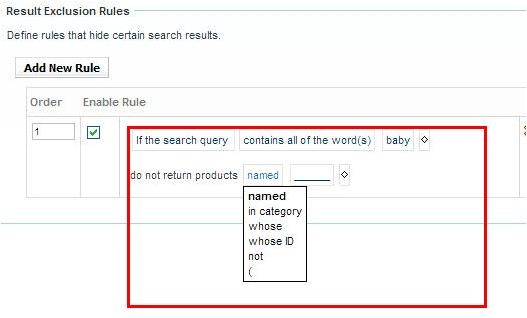
Below you could find the screen shot of a sample Result Exclusion rule for the searches with search keyword contains all of the words baby.

Below you could find the screen shot of a sample Result Positioning rule for the searches with search keyword contains all of the words tv.


Comments

  1. Sony kindly post some more example on Result Positioning rule to understand How it works.

    ReplyDelete
  2. Sorry, I don't have the Search set up now. The result positioning is pretty straight forward and all the matching results will be positioned at the top. If you have any specific queries, please ask.

    ReplyDelete
  3. Hi Sony,

    Need some help. I have successfully configured search rules in /atg/bcc and deployed.
    But on commerce site if I search with that keyword it is not redirecting.
    Any specific reasons.
    Please refer this link to understand the problem better...
    https://kr.forums.oracle.com/forums/thread.jspa?threadID=2423279


    Thanks in Advance.

    ReplyDelete
  4. ATG out of box SearchFormHandler and droplets have an autoRedirect property that specifies whether the form handler should check the search results for a redirect URL or not. Check this

    ReplyDelete
  5. How do I add another keyword that associates with the same one for example "Sharkbite" pull up search results but when entered in "shark bite" separately no results found. I would like to know how to add a word differentiation and make it live.

    ReplyDelete
  6. If you want to get the results of some other word, you can use the dictionary and give some synonyms. Also give "mode=AND" in the request attributes.

    ReplyDelete

Post a Comment

Popular posts from this blog

Eclipse Kepler 4.3 is now available

Check out Eclipse Kepler 4.3 @  http://www.eclipse.org/downloads/

Basic design decisions for a commerce search setup ( with an ATG Search view)

In this blog I would like to explain the basic set of configuration/design decisions needed to setup an ATG search project. Most of these design decisions are common for all Enterprise search applications. 1. Decide the searchable properties :   This means the properties that the business want the user to search in the ecommerce platform. In ATG search these are configured as the text properties in the product-catalog-output-config.xml ( the definitionFile of the \atg\commerce\search\ProductCatalogOutputConfig). Usually the displayName of product/sku, displayName of department/category/sub-category, skuId, brandName are the properties configured as searchable. 2. Decide the search refinement properties or the faceted properties :   After a user search for a keyword, search refinement is the next step done to filter his results. ATG supports the search refinement using the Faceted Search concept. Read more about facted search @...

ATG Product Catalog schema ER diagram

Check out the O rder schema ER-Diagram @   http://tips4ufromsony.blogspot.in/2012/02/atg-order-schema-er-diagram.html Check out the User Profile  schema ER-Diagram @ http://tips4ufromsony.blogspot.in/2012/03/atg-user-profile-schema-er-diagram.html If you would like to know the relationship between different Product Catalog tables, please find below screen shots of  Product Catalog schema ER Diagrams.

Eclipse Juno - good features of Eclipse 4.2 ( Eclipse Juno ) JDT/Workbench

Global search bar The workbench now has a global search field in the tool bar. Multi-drag sash You can now place the cursor at the intersection of two or more sashes and drag them all at the same time. When you are going to be dragging multiple sashes, the cursor will change to one with 4-way arrows. The image below indicates one such intersection with a red circle. Ant updated to 1.8.3 and JUnit to 4.10 The bundled version of Apache Ant in the platform has been updated to version 1.8.3. The JUnit 4 version shipped with Eclipse has been updated to 4.10. CamelCase in Quick Outline The Quick Outline (Ctrl+O) and Quick Hierarchy (Ctrl+T) in the Java Editor now also support camelCase matching on the element name, quite similar to the Open Type dialog and Content Assist. Quick Assist to convert enhanced for loop Ever encountered an enhanced for loop and needed access to the Iterator or to the loop index? Now, you can just use a Quick Assist (Ctrl+1)...

Eclipse Indigo - good features of Eclipse3.7 ( Eclipse Indigo ) JDT/Workbench

Lightweight refresh on access Previous Eclipse versions relied on native refresh providers (on Windows) or a polling mechanism to keep the workspace synchronized with the underlying file system. This capability can be still enabled by selecting Refresh using native hooks or polling on  Preferences > General > Workspace. Now a new lightweight mechanism is available. Files discovered to be out-of-sync by the workspace, for example while accessing the file content by an editor, will be automatically asynchronously refreshed. If you want to refresh files this way, go to  Preferences > General > Workspace and select Refresh on access. The Problems view icon shows state The Problems view icon now indicates whether the view contains warnings or errors. This is especially useful when working with maximized editor area as it allows you to see whether there are errors or warnings without going to the Problems view. Branch column in History view There is now...