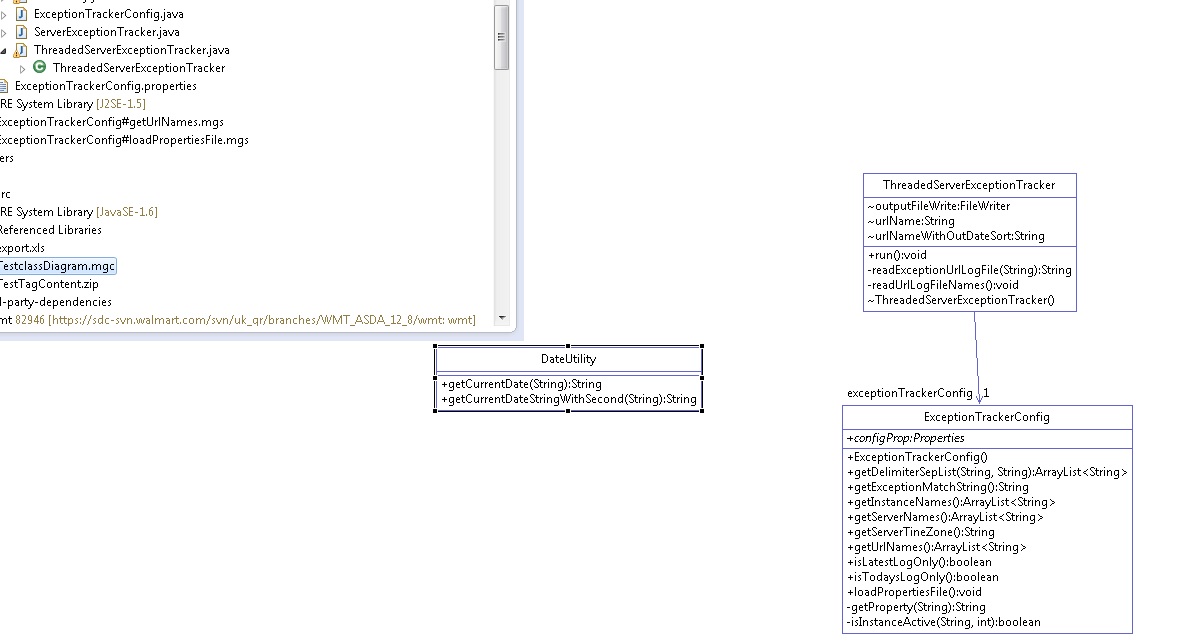
Eclipse plug-in to create Class and Sequence diagrams

ModelGoon is an Eclipse plug-in avaiable for UML diagram generation from Java code. It can be used to generate Package Dependencies Diagram, Class Diagram, Interaction Diagram and Sequence Diagram.


You coud get it from http://marketplace.eclipse.org/content/modelgoon-uml4java

Read more about it and see some vedios about how to create the class and sequence diagram @ http://www.modelgoon.org/?tag=eclipse-plugin

Find some snapshots below which gives an idea about the diagram generation.


Comments

  1. This comment has been removed by the author.

    ReplyDelete
  2. I am unable to update my ECLIPSE with ModelGoon Plug via MPlace.
    It says invalid repository location.
    http://www.modelgoon.org/?page_id=75

    ReplyDelete
  3. yes even i got the same issue.

    ReplyDelete
  4. Let me check and update you with in a couple of days....

    ReplyDelete
  5. I am able to install ModelGoon in my eclipse indigo. Which Eclipse version you guys tried ?

    @ Eclipse market place search for ModelGoon and install it. Thats all......

    ReplyDelete
  6. This comment has been removed by the author.

    ReplyDelete
  7. Its working fine! but anyone could suggest me getting those sequence diagrams without those loops and conditions label. If its not possible doing here is there anyother plugin where i can acheive this.

    ReplyDelete
  8. Nice one....For creating a sequece diagram do we have a class level option in this.
    As of now i can only see method level ?

    ReplyDelete

Post a Comment

Popular posts from this blog

JBoss - know more about the JBoss directory structure

Fundamentally, the JBoss architecture consists of the JMX MBean server, the microkernel, and a set of pluggable component services - the MBeans. The JBoss Application Server ships with three different server configurations. Within the <JBoss_Home>/server directory, you will find three subdirectories: minimal, default and all. The default configuration is the one used if you don’t specify another one when starting up the server. If you want to know which services are configured in each of these instances, look at the jboss-service.xml file in the <JBoss_Home>/server/<instance-name>/conf/ directory and also the configuration files in the <JBoss_Home>/server/<instance-name>/deploy directory. JBoss 4.0 features an embedded Apache Tomcat 5.5 servlet container. conf --> The conf directory contains the jboss-service.xml bootstrap descriptor file for a given server configuration. This has the jboss-log4j.xml file which configures the Apach...

ATG Product Catalog schema ER diagram

Check out the O rder schema ER-Diagram @   http://tips4ufromsony.blogspot.in/2012/02/atg-order-schema-er-diagram.html Check out the User Profile  schema ER-Diagram @ http://tips4ufromsony.blogspot.in/2012/03/atg-user-profile-schema-er-diagram.html If you would like to know the relationship between different Product Catalog tables, please find below screen shots of  Product Catalog schema ER Diagrams.

ATG CA - different activity sources used @ BCC

Read about how a new link can be added in BCC home page @  http://tips4ufromsony.blogspot.com/2012/03/atg-ca-bcc-home-screen-how-to-add-new.html Normally an ActivitySource.properties file define the set of actions that it supports under a genericActivityDefinitionFile. But some ActivitySource.properties  define the actions  using the workflowActivityDefinitionFiles. For example consider the default "Content Administration" ,  "SearchAdministration",  " Merchanding "  and "Personalization" options in BCC homepage. Below I listed the ActivitySource.properties and other properties for these links. To get all these activitysource names, just take the / atg/bizui/activity/ActivityManager  component @ dyn/admin. Content Administration ActivitySource  --> /atg/bizui/activity/PublishingActivitySource genericActivityDefinitionFile Search Administration ActivitySource  --> /atg/bizui/...

How can we use SOAP UI to test ATG search

The call from the ATG commerce instance ( Estore instance ) to the search engine is done using the SOAP protocol. Read more about this architecture @  http://tips4ufromsony.blogspot.com/2011/11/atg-search-architectural-flow-search.html . If you have a SOAP UI tool (get it from @  http://www.soapui.org/ ), you could test the request/response from the search engine. You could find the wsdl for this SOAP in the folder in which your ATG search engine is installed. Below screen shot has the deatils of the wsdl : To call the search engine you need to know the port in which the search engine is running. You could get it from the SearchEngineService component of the commerce instance @ /dyn/admin/nucleus/atg/search/routing/SearchEngineService/.  Once you have these details, you could call the search engine with a sample request and a query string to get the response.

Google Chrome shortcut keys

If you are a Google Chromey guy, please find below the list of shortcut keys for some of the most used features  :-) Find more shortcut keys @  http://www.google.com/support/chrome/bin/static.py?page=guide.cs&guide=25799&topic=28650