
ATG Search - how to define the search configuration rules

ATG Search configuration rules are specified through the ATG BCC Merchandising UI. Over here you could specify the below set of rules
  1. Redirection rules --> If you want to redirect to another page other than the search result page for a search keyword
  2. Property Prioritization rules  --> Prioritize certain set of properties and give weightage
  3. Result exclusion rules  --> Exclude certain search results
  4. Result positioning rules  --> Position / Sort the search result data


1.  To create the search configuration tree, you need to log-in to the ATG BCC Merchandising UI and select the Search Configuration Tree in the Browse tab drop down. Now need to click the Create button and first you need to create the Search Configuration Folder.


2.  When you create the folder, give the name of the folder and select whether the contents vary by Language or Segment. If your ecommerce site need to support more than one language and you need to configure different locale specific rules, please select the contents vary by Language option.


3.  After you create the folder, you could click the create the Search Configuration button and specify the Name and the Locale. These locale values are populated in the drop down from the component /atg/search/config/LanguageDimensionService


4. Once you create the Search Configuration,  you can add different rules like Redirection, Result Exclusion,...


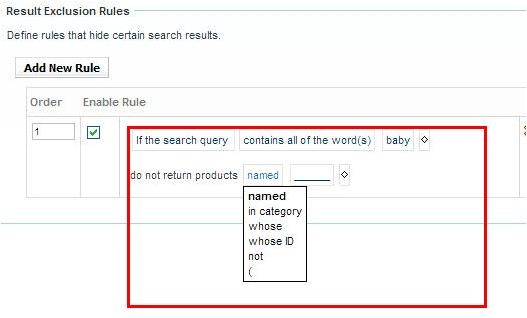
Below you could find the screen shot of a sample Result Exclusion rule for the searches with search keyword contains all of the words baby.

Below you could find the screen shot of a sample Result Positioning rule for the searches with search keyword contains all of the words tv.


Comments

  1. Sony kindly post some more example on Result Positioning rule to understand How it works.

    ReplyDelete
  2. Sorry, I don't have the Search set up now. The result positioning is pretty straight forward and all the matching results will be positioned at the top. If you have any specific queries, please ask.

    ReplyDelete
  3. Hi Sony,

    Need some help. I have successfully configured search rules in /atg/bcc and deployed.
    But on commerce site if I search with that keyword it is not redirecting.
    Any specific reasons.
    Please refer this link to understand the problem better...
    https://kr.forums.oracle.com/forums/thread.jspa?threadID=2423279


    Thanks in Advance.

    ReplyDelete
  4. ATG out of box SearchFormHandler and droplets have an autoRedirect property that specifies whether the form handler should check the search results for a redirect URL or not. Check this

    ReplyDelete
  5. How do I add another keyword that associates with the same one for example "Sharkbite" pull up search results but when entered in "shark bite" separately no results found. I would like to know how to add a word differentiation and make it live.

    ReplyDelete
  6. If you want to get the results of some other word, you can use the dictionary and give some synonyms. Also give "mode=AND" in the request attributes.

    ReplyDelete

Post a Comment

Popular posts from this blog

SOAP UI faster start up

If you feel like your SOAP UI is starting up very slowly, check whether this is due to any start up web page call. You can check this @ Preferences - UI Settings - Show Startup Page ==> Here you can deselect this option to improve the start-up time.

ATG CA - BCC home screen : how to add a new link

          Activity source is the property which controls the links on the left nav on the BCC home screen. All activity sources are registered with the ActivityManager component at /atg/bizui/activity/ActivityManager . When rendering the BCC home page, the ActivityManager cycles through all the registered ActivitySource components and displays left navigation links for each of them on the BCC home page. For example if I want to add a new link "My New Link" , below screen shots exaplins how this can be done 1. Add  activityManager.properties to specify the activityresources. In this  activityManager, I specified one MyActivitySource. 2. Add  MyActivitySource.properties  to specify the name of the link and the other details . Here it refers to a bundle properties file.  3. Add  the bundle properties file  to specify the name of the link.  4. Now you could see the new link...

How to simulate Browser back button

When someone asks how to simulate a back button, they really mean to ask how to create a link that points to the previously visited page. Most browsers tend to keep a list of which websites the user has visited and in what order they have done so. The DOM window object provides access to the browser's history through the history object. Moving backward and forward through the user's history is done using the   back(), forward(), and go() methods of the  history  object. To move backward through history, just do window.history.back() ; This will act exactly like the user clicked on the Back button in their browser toolbar. Find below a sample html code: <html> <head> <script type="text/javascript"> function goBack(){  window.history.back() } </script> </head> <body>    <input type="button" value="Back" onclick="goBack()" /> </body> </html>

ATG Search Indexing - overview of different steps in search indexing

Read more about the search indexing behind the scene steps @  http://tips4ufromsony.blogspot.in/2011/12/atg-search-indexing-behind-scene-steps.html ATG Search prepares searchable content by indexing the products specified in the XML definition file (/atg/commerce/search/ProductCatalogOutputConfig). Generally there are two types of indexing 1.  Full Indexing  --> all data taken for indexing 2.  Incremental Indexing --> only changed data will be taken for indexing When full indexing is triggered, following happens:    1. The out of box component BulkLoader will call IndexedItemsGroup.getGroupMembers() to load the products to the XHTL document. It prevents uncategorized products from getting indexed. The definition file format begins with a top-level item as a product and includes the properties of parent category and childskus. For each product, the set of Variant Producers configured in ProductCatalogOutputConfig is execute...

ATG search installation and search engine log files

Here I would like to explain how your ATG search folder structure looks like after you do the ATG search installation and also about the search engine log files. To get the ATG search, you need to install the ATGSearch<version>Windows.exe after you do the ATG installation. When you install ATG search, the generated folders include an OS dependant folder. In the below screen shot, you could see the "i686-win32-vc71" folder and this is generated since the ATG search ins installed in a windows machine. The ATG search engine is actually an exe file inside this "i686-win32-vc71" folder. Below screen shot give you an idea about the "atgsearch.exe", which is the search engine application. This search engine application (atgsearch.exe) is started by a remote launcher call from the BCC search administration UI.  The log files like "atgsearch_20120106112413_568.log" are the search engine log files where you could see the engine ...