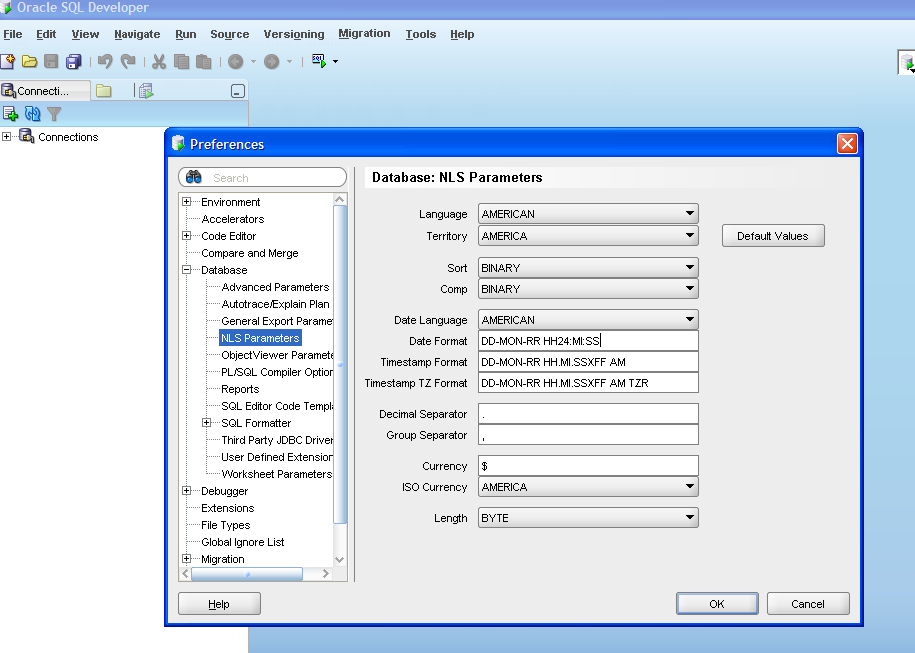
Display date and time for a DATE field @ SqlDeveloper


For date fields, by default SQL Developer will display only the date without time. To set it to display the time as well, do the following:

  1. Go to SQL Developer –> Tools >> Preferences.
  2. Select Database >> NLS Parameters from the left panel.
  3. From the list of NLS parameters, enter DD-MON-RR HH24:MI:SS into the Date Format field.
  4. Save and close

Comments

Popular posts from this blog

Eclipse plug-in to create Class and Sequence diagrams

ModelGoon is an Eclipse plug-in avaiable for UML diagram generation from Java code. It can be used to generate Package Dependencies Diagram, Class Diagram, Interaction Diagram and Sequence Diagram. You coud get it from http://marketplace.eclipse.org/content/modelgoon-uml4java Read more about it and see some vedios about how to create the class and sequence diagram @ http://www.modelgoon.org/?tag=eclipse-plugin Find some snapshots below which gives an idea about the diagram generation.

ATG - quick reference to commonly used DSP Tags

In this blog, I would like to give a quick reference to the most commonly used DSP Tags.Note that in this DSP tag details : bean refers to a Nucleus path, component name, and property name param refers to a Page parameter value refers to a Static-value var refers to a EL variable id refers to a scripting variable ============================================================== 1.dsp:importbean     example: <dsp:importbean bean="/atg/dynamo/droplet/Switch"/> ============================================================== 2.dsp:page     usage: It encloses a JSP. The dsp:page invokes the JSP handler, which calls the servlet pipeline and generates HTTPServletRequest.    example:    <dsp:page> ..... </dsp:page> ============================================================== 3.dsp:include     usage: Embeds a page fragment in a JSP.     example:   <dsp:include src="/myPage/Result...

How to convert your Blogger Blog to PDF ?

You can use a website called "blogbooker" @  http://www.blogbooker.com/blogger.php   to convert your Blogger Blog to a PDF . Please find the steps below : 1. Save your blog as an xml using Blogger Settings - Other - Export Blog option 2. Go to the website " http://www.blogbooker.com/blogger.php " and select this XML , give your blog address and select the options like date range, page size, font, ... 3. Click the  "Create Your BlogBook" button to view and save your blog as PDF

ATG - more about Forms and Form Handlers

An ATG form is defined by the dsp:form tag, which typically encloses DSP tags that specify form elements, such as dsp:input that provide direct access to Nucleus component properties. Find below a sample dsp:form tag.    <dsp:form action="/testPages/showPersonProperties.jsp" method="post" target="_top">      <p>Name: <dsp:input bean="/samples/Person.name" type="text"/>      <p>Age: <dsp:input bean="/samples/Person.age" type="text" value="30"/>      <p><dsp:input type="submit" bean="/samples/Person.submit"/> value="Click to submit"/>    </dsp:form>   When the user submits the form, the /samples/Person.name property is set to the value entered in the input field.Unlike standard HTML, which requires the name attribute for most input tags; the name attribute is optional for DSP form element tags. If an input tag omits the n...

ATG - how to use the Transaction Manager

Basic concepts of Java transaction In its simplest definition, a transaction is a set of actions that is treated as an atomic unit; either all actions take place (the transaction commits), or none of them take place (the transaction rolls back). Managing transactions is one of the primary tasks of an application server. The application server keeps track of transactions, remembering which transaction is associated with which request, and what transactional resources (such as JDBC or JMS connection) are involved. Each active transaction is represented by a transaction object, which implements the interface javax.transaction.Transaction. A transaction is usually associated with a thread and only one transaction can be associated with a thread at any one time. A central service, called the Transaction Manager, is responsible for keeping track of all these transactions. The Transaction Manager is implemented through the Java Transaction API (JTA). Transaction and Dynamo ap...